A workshop, a reserve, a digital school and a research community may appear to be separate realities. The project’s foundational texts connect them through a shared function: bringing dispersed capabilities together and creating conditions in which knowledge can remain useful, shared and transmissible.
The Totonacapan Institute gives this work a cultural and territorial form within The Integral Management Society. Its starting point is concrete: the lineage of craft and service associated with La Bola de Oro in Papantla, the memory of the people who sustained it and the documents through which it can be studied. From these roots emerge questions about education, tools, technological transformation and artificial intelligence.
The community of practice as a unit of work
The Institute’s focus brings people together, as well as objects. A master who can diagnose a fault, an apprentice beginning to distinguish materials, a toolmaker and a person preserving a document contribute to the same continuity. Knowledge circulates through observation, correction, use and trust.
Caring for an object therefore also means asking how it was made, for whom, with which resources, who learned alongside its maker and what the craft needs to continue. Curatorial work connects the archive, workshop, encounter and learning.
EDITORIAL PLATE · AI-GENERATED RECREATIONFrom the object to living knowledge: observing, practising, documenting and passing on skills. Conceptual scene: it does not depict an identified workshop or historical document.
A family history opening into cultural work
The memory assembled for the Institute connects Genaro Vargas Tapia with the founding of La Bola de Oro in 1898. The printed records of 1904 and 1913 are material landmarks that visitors can consult directly. The family account describes a workshop in which learning, repair and service reinforced one another.
The texts on Luz Carmen Vargas Carrera’s trajectory extend this outlook to textiles, cultural promotion and communication. They recall the radio programme Nuestras Raíces as a way of bringing cultural memory to younger generations. This memory of work belongs to the project’s narrative archive and is presented as testimony.
Margarita Reyes Parra: medicine reaching communities
FAMILY MEMORY · HISTORICAL RECREATIONMedical visit to a rural settlement near Papantla, around 1960. An AI-generated artistic recreation inspired by family testimony; it is neither a period photograph nor a verified portrait of Margarita Reyes Parra.
María del Carmen Vargas Carrera remembers her grandmother, Dr Margarita Reyes Parra, who trained at the National Autonomous University of Mexico and arrived in Papantla around 1960. According to family memory, she had a consulting room on the upper floor of the Hotel Tajín and also travelled to rural settlements to care for people who found it difficult to attend a consultation. Carmen recalls that she often put caring for people before charging for her services and that she died with limited means. Her story broadens the memory of Papantla’s crafts and services: a professional practice sustained by its relationship with the community.
The Posada: receiving a matter and helping it continue
A Posada may be a workshop, an archive or a carefully held conversation. Its task is to understand what a person brings, which knowledge they need and which encounter might help. The institution offers tools, memory and continuity; the visitor’s matter remains at the centre.
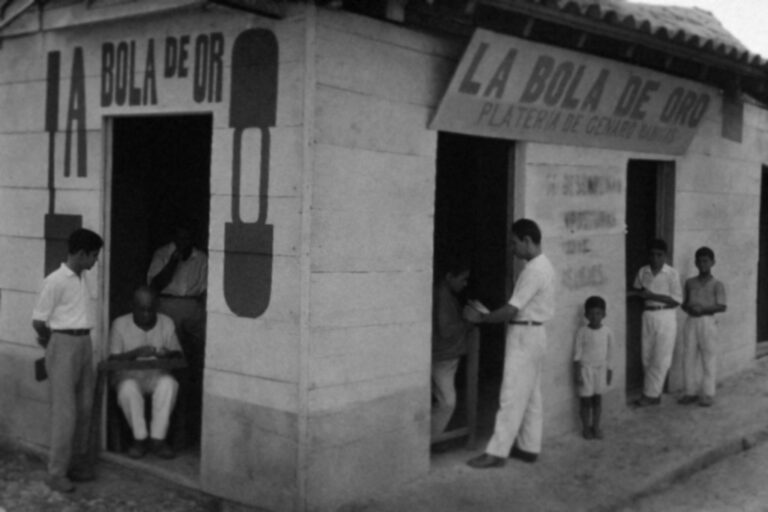
Historic façade of La Bola de Oro. La Bola de Oro collection. Photograph preserved in the site’s library. Date and photographer unrecorded. Read the institutional history (Spanish) →
Two proposed work programmes
Each proposal begins with a particular object or practice and sets out a result that can be shared back with the people who contributed their knowledge.
01
Craft memory
Connect an archival item with a technique, its vocabulary and the decisions made by the practitioner.
Proposed first output
An annotated record linking the source to an authorised account or demonstration.
Heritage includes the ability to keep creating, repairing, learning and passing knowledge on.
The International Institute of Culture of Totonacapan develops the cultural and territorial work of The Integral Management Society (IMSV), a non-profit association established in Geneva in 2024. It connects documentation, archives, research and cooperation around the practices and memories associated with Totonacapan.
Mission
To document, preserve, transmit and give cultural visibility to the territory’s knowledge, crafts, expressions and memories. This work starts with relationships between people, tools, materials, contexts and generations: the conditions that enable a practice to continue.
Continuity of practice
The Institute’s history relates to an artisanal and documentary line in Papantla centred on La Bola de Oro. This historical continuity of people, crafts and archives predates the present Swiss association. It does not mean that IMSV legally existed in the nineteenth century.
1898
The artisanal line
Beginning of the documented historical activity of La Bola de Oro in Papantla.
1904 / 1913
Surviving documents
Silverwork, jewellery and optics in two items from the historical collection.
2024
Established in Geneva
The Swiss legal entity The Integral Management Society is constituted.
2026
The Institute’s framework
Development of its cultural, documentary and transmission framework within IMSV.
How it works
Documentation preserves provenance; research distinguishes sources and testimony; transmission recognises knowledge holders; cooperation defines responsibilities before commitments. The Institute connects these areas through work grounded in context and open to exchange.
Institutional framework and governance
The Institute is an internal structure of IMSV, with no separate legal personality. Institutional decisions belong to the association’s competent bodies. The custody of collections and the rights of authors and rights holders are respected in each use.
Its territorial focus does not confer political, ethnic or exclusive representation of Totonacapan or its communities. Cooperation is built with participants and within the specific mandate concerned.
Institutional documentation
The French statutes are the legal reference. The Spanish, English and French explanations on this website are informational texts. To consult documentation or clarify the framework for cooperation, please contact the Institute.
Our mission: to be a posada and help create others
The International Institute of Totonacapan Culture exists to be a posada and help sustain other posadas: meeting places where people and communities of practice find a welcome, a shared memory, tools and relationships that help them and their knowledge continue on their way.
We bring together artisans, masters, apprentices, Indigenous and rural communities, researchers, naturalists, travellers and institutions. A posada can be a workshop, a house, an archive, a circle of cooperation, a research residency, a reserve or a digital space. It is defined by the encounters it makes possible, which might scarcely happen otherwise.
We support communities of practice in preserving, researching, documenting and passing on knowledge. Objects and documents matter to us, as do people, gestures, techniques, stories and the conditions that allow knowledge to stay alive and evolve. An encounter can open new perspectives, capacities and paths.
A history of encounters and continuity
This vocation is rooted in Papantla. Since 1898, the work centred on La Bola de Oro has sustained communities of practice in jewellery, silversmithing, watchmaking, optics, repair, services and the adaptation of new techniques, in a continuous history documented in legal records. Workshops were places of work as well as of trust, learning, correspondence and exchange across generations and cultures.
For the period before La Bola de Oro, research into the site reconstructs the memory of a house and estate associated with Papantla’s tradition of botany and natural history and the vanilla trade, with the García–Silvera family and later with Pedro J. Tremari. The Posada Humboldt forms part of this history of hospitality and exchange among residents, travellers, naturalists and researchers. This sequence explains why we speak of posadas long before the present-day Institute, even as the specific connections remain under investigation. A visit by Alexander von Humboldt has not been established. Through revolutions, political upheaval and economic and technological change, the vocation of encounter and transmission has continued.
The Institute is part of The Integral Management Society (IMSV), a Swiss association based in Geneva. It is the association’s cultural circle dedicated to Totonacapan, the preservation of living heritage and cooperation among communities and institutions. We serve and connect people while respecting each community’s autonomy, identity and voice.